


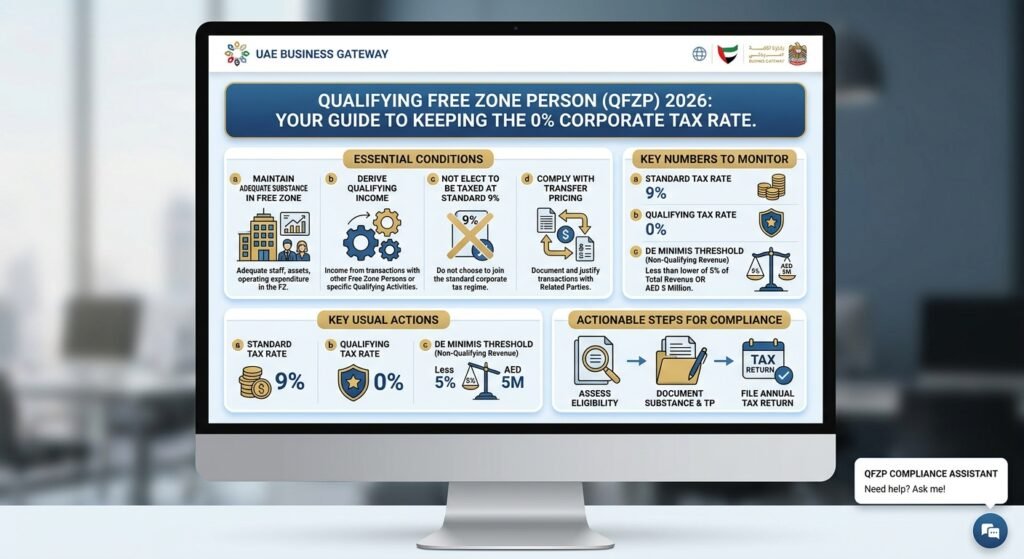
One of the biggest attractions of a UAE free zone is the 0% corporate tax rate. But here is what many free zone business owners discover only at filing time: the 0% rate is not automatic. It is available only to a Qualifying Free Zone Person (QFZP) — a company that meets a specific set of conditions. Fail even one, and you can lose QFZP status and pay 9% on your profits.
As free zone companies work through their corporate tax returns, this is the make-or-break question. This guide explains what a QFZP is, the exact conditions you must meet, what counts as “qualifying income,” and how to protect your 0% rate.
What is a Qualifying Free Zone Person?
A Qualifying Free Zone Person is a legal entity established in a UAE free zone that meets all the conditions set by the Corporate Tax Law to benefit from a 0% rate on its qualifying income. Income that does not qualify is taxed at the standard 9%.
The key mental model: being in a free zone gets you in the door. Being a QFZP — and keeping that status — is what actually delivers the 0% rate. The two are not the same thing.
The conditions to be (and stay) a QFZP
To be a Qualifying Free Zone Person, your company must meet all of the following:
1. Maintain adequate substance in the UAE. You must carry out your core income-generating activities in the free zone, with adequate staff, assets and operating expenditure. A “letterbox” company will not qualify.
2. Derive qualifying income. Your income must fall within the categories the law defines as qualifying (explained below).
3. Not have elected for standard corporate tax. A free zone person can choose to be taxed under the normal 9% regime; if you elect in, you give up QFZP status.
4. Meet the de minimis requirement. Your non-qualifying revenue must not exceed the lower of 5% of your total revenue or AED 5 million. Breach this, and you lose QFZP status.
5. Prepare audited financial statements. Audited accounts are mandatory for a QFZP.
6. Comply with transfer pricing rules. You must meet the arm’s-length principle and maintain transfer pricing documentation where required.
Miss any single condition and you can be disqualified — not just for that income, but for the entire tax period, and potentially subsequent periods. That is why QFZP status is something to manage proactively, not check once a year.
What counts as “qualifying income”?
This is where most of the confusion — and most of the risk — sits. Broadly, qualifying income can include:
- Income from transactions with other free zone persons (where that person is the beneficial recipient), and
- Income from qualifying activities conducted with mainland or foreign parties, and
- Income that falls within specified categories set by Cabinet decision.
Qualifying activities typically include areas such as manufacturing and processing of goods, holding of shares and securities, ship ownership and operation, reinsurance, fund and wealth management (regulated), headquarters services to related parties, treasury and financing services to related parties, and the distribution of goods from a designated zone.
Excluded activities — which generally do not qualify — typically include income from certain transactions with natural persons, regulated banking, insurance and finance activities (outside the qualifying carve-outs), and income from immovable property (with specific treatment for commercial vs other property). Income from excluded activities is taxed at 9% and also counts toward your de minimis limit.
The practical trap: a small amount of the wrong kind of income — say, a modest mainland service that is not a qualifying activity — can, if it breaches de minimis, cost you the 0% rate on all your income. The amounts that trigger disqualification are often surprisingly small relative to the tax at stake.
Free zone vs mainland: it’s not just about tax
Because of these conditions, the “free zone = 0% forever” assumption is outdated. For some businesses — particularly those trading heavily with the mainland or serving individual customers — a mainland structure taxed at 9% may be simpler and more predictable than constantly managing QFZP conditions. For others, the free zone 0% rate is a genuine and valuable advantage worth structuring around.
The right answer depends on who your customers are, what you sell, and where your income comes from — which is a decision best made at the setup stage, not discovered at the first filing.
How to protect your 0% rate
If you want to keep QFZP status, build these habits:
- Classify your income correctly between qualifying and non-qualifying — throughout the year, not in arrears.
- Watch the de minimis line continuously, so a stray transaction doesn’t tip you over.
- Maintain real substance in the free zone.
- Keep audited financials and transfer pricing documentation current.
- Review your structure if your customer mix is shifting toward the mainland or individuals.
How HM Corporate Services can help
HM Corporate Services works across both business setup and corporate tax, which is exactly the combination QFZP planning requires. We help free zone businesses:
- Assess QFZP eligibility and quantify the value of the 0% rate for your specific activity.
- Classify qualifying vs non-qualifying income and monitor the de minimis threshold.
- Structure the business — free zone vs mainland — to match your customer base and goals.
- Prepare audited financials, transfer pricing documentation and the corporate tax return.
The 0% rate is worth protecting — but only if you actually qualify. Book a QFZP eligibility review with HM Corporate Services → and make sure your free zone status is working for you.
Frequently asked questions
Is corporate tax 0% for all free zone companies? No. The 0% rate applies only to a Qualifying Free Zone Person on its qualifying income. Free zone companies that fail the QFZP conditions, or income that is non-qualifying, are taxed at 9%.
What is the de minimis rule for free zone companies? Your non-qualifying revenue must not exceed the lower of 5% of total revenue or AED 5 million. Exceeding this threshold causes you to lose QFZP status for the tax period.
What is qualifying income for a QFZP? Broadly, income from transactions with other free zone persons and income from specified qualifying activities. Excluded activities — such as certain dealings with individuals, non-carve-out finance/insurance, and most immovable property income — do not qualify.
Do QFZPs still have to file a corporate tax return? Yes. A Qualifying Free Zone Person must register for corporate tax and file a return, even though its qualifying income is taxed at 0%.
Can I lose my 0% rate? Yes. Breaching any QFZP condition — including the de minimis limit, substance requirement, or transfer pricing rules — can disqualify you, and the standard 9% rate can then apply to your income for that period and potentially beyond.
