


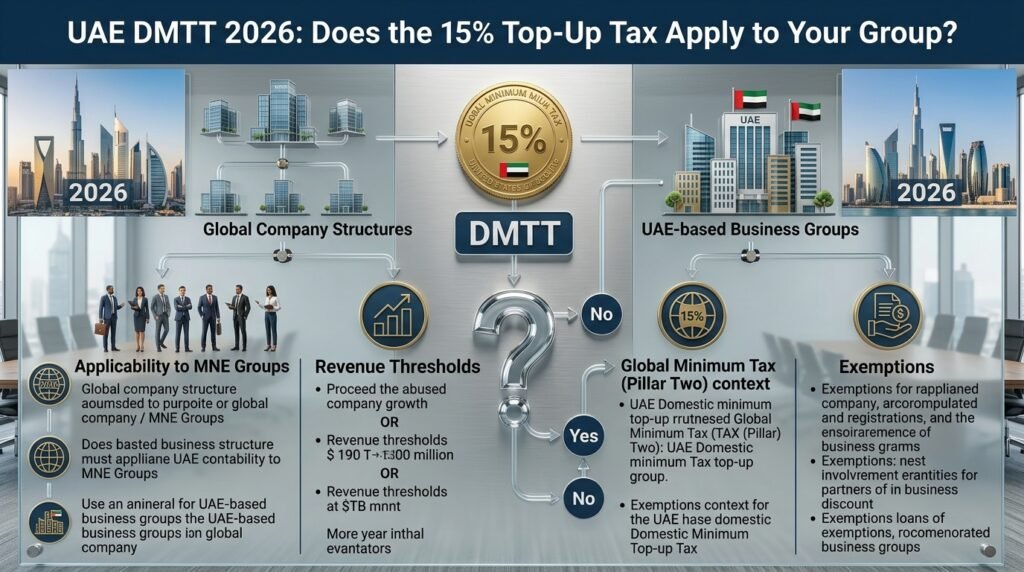
For most UAE businesses, corporate tax means 9% above AED 375,000. But for large multinational groups, a second, higher regime now applies: the Domestic Minimum Top-up Tax (DMTT), which ensures a minimum effective tax rate of 15% on UAE profits. It took effect for financial years starting on or after 1 January 2025, and if your group is in scope, this is a board-level compliance obligation — not a footnote.
This guide answers the one question every affected CFO and tax director is asking: does the DMTT apply to us, and if so, what do we actually have to do?
What is the DMTT, in one paragraph?
The DMTT is the UAE’s implementation of the OECD’s Pillar Two global minimum tax. Under Pillar Two, large multinational groups should pay at least 15% tax on their profits in every jurisdiction they operate in. If a group’s effective tax rate in the UAE falls below 15%, a “top-up” is charged to bring it up to that level. By enacting a Qualified Domestic Minimum Top-up Tax (QDMTT) through Cabinet Decision No. 142 of 2024, the UAE ensures that this top-up is collected in the UAE — rather than being handed to another country’s tax authority.
For groups that benefit from low-tax structures, free-zone 0% treatment, or incentives, this is the mechanism that can pull the effective rate back up to 15%.
Does it apply to your group? The scope test
The DMTT does not apply to ordinary UAE companies or SMEs. It targets large multinational enterprise (MNE) groups. In broad terms, your group is likely in scope if:
- It is a multinational group (operating in more than one country), and
- It has consolidated annual revenue of EUR 750 million or more in at least two of the four financial years immediately preceding the tested year.
That EUR 750 million threshold is the same one used across the OECD Pillar Two framework worldwide, so if your group is already assessing Pillar Two globally, the UAE DMTT is part of the same picture.
Quick self-check: Multinational group?
✔ Consolidated revenue ≥ EUR 750M in 2 of the last 4 years?
✔ Operations or entities in the UAE?
✔ — If all three are yes, you need a DMTT impact assessment.
Standalone UAE businesses, purely domestic groups, and groups below the revenue threshold generally fall outside the DMTT and remain under the standard 9% corporate tax regime.
Why this matters even in a “0% or 9%” country
A common misconception is that because the UAE’s headline corporate tax is only 9% — and free zones can be 0% — there is “no top-up to worry about.” That is exactly backwards.
If your UAE effective rate is below 15% (which 9%, and certainly 0%, can be), an in-scope group faces a top-up to 15%. The practical questions then become:
- Where is that extra tax paid? The UAE’s QDMTT means it is collected here, not abroad.
- How is the effective rate calculated? Pillar Two uses its own detailed rules (GloBE income, covered taxes, substance-based carve-outs) — not simply your accounting profit.
- What reliefs apply? Substance-based income exclusions and safe harbours can reduce or defer the top-up, but only if properly claimed.
This is why in-scope groups cannot rely on their standard corporate tax return alone.
What in-scope groups need to do
If your group is caught by the DMTT, the compliance workstream typically includes:
1. Confirm scope and entities. Identify every UAE constituent entity of the group and confirm the revenue-threshold test.
2. Register for DMTT. In-scope entities are required to register with the FTA for the top-up tax within the prescribed timeframe.
3. Calculate the effective tax rate under GloBE rules. This is the technical core — computing GloBE income, covered taxes and the jurisdictional ETR for the UAE.
4. Apply carve-outs and safe harbours. Substance-based income exclusions (based on payroll and tangible assets) and transitional safe harbours can materially reduce the top-up.
5. File and pay the top-up. Prepare and submit the DMTT return and pay any top-up due within the deadlines.
6. Align with global Pillar Two reporting. Ensure the UAE position is consistent with the group’s GloBE Information Return and reporting in other jurisdictions.
The risk of getting it wrong
The DMTT is new, technically demanding, and carries the same enforcement exposure as the rest of the UAE tax regime — plus the reputational and group-level risk of a material misstatement in Pillar Two reporting that spans multiple countries. Under-provisioning, missing the registration deadline, or misapplying the ETR calculation can lead to penalties in the UAE and knock-on adjustments elsewhere in the group. For a EUR 750M+ group, the sums involved are rarely small.
How HM Corporate Services supports MNE groups
The DMTT sits at the intersection of UAE domestic tax and international Pillar Two rules — an area where generic advice is not enough. HM Corporate Services helps multinational groups with:
- A DMTT impact assessment — a clear yes/no on scope, and a quantified view of any top-up exposure.
- DMTT registration with the FTA within the deadlines.
- Effective-tax-rate modelling under GloBE rules, including carve-outs and safe harbours.
- Return preparation and filing, aligned with your group’s global Pillar Two compliance.
If your group is above EUR 750 million, the only wrong move is assuming the DMTT doesn’t reach you. Request a confidential DMTT impact assessment from HM Corporate Services →.
Frequently asked questions
What is the UAE DMTT? The Domestic Minimum Top-up Tax is the UAE’s implementation of the OECD Pillar Two global minimum tax. It ensures large multinational groups pay an effective rate of at least 15% on their UAE profits, with any top-up collected in the UAE.
When did the UAE DMTT take effect? It applies to financial years starting on or after 1 January 2025, under Cabinet Decision No. 142 of 2024.
Who does the DMTT apply to? Multinational groups with consolidated annual revenue of EUR 750 million or more in at least two of the four preceding financial years. Standalone UAE businesses and groups below the threshold are generally outside its scope.
Does the DMTT replace the 9% corporate tax? No. The standard 9% corporate tax regime continues for most businesses. The DMTT is an additional top-up that applies only to in-scope large multinational groups whose UAE effective rate falls below 15%.
Do free zone companies pay the DMTT? A free zone entity that is part of an in-scope multinational group can be subject to the DMTT even if it otherwise benefits from a 0% rate — because Pillar Two tests the group’s effective rate against the 15% minimum.
